Reference
Every rule of Runewards
Every rule, every number, and every keyword the game uses — how a match is decided, what goes in a deck, what the rarities mean, how many cards there are and how you get them. Where a card’s text and the card’s behaviour disagree, both are given and the one that wins is marked.
Ask about a rule
Type a question in your own words — about a rule, or about any of the cards. The answer is written from this page and the game’s card list, and it points at what it came from so you can check it.
Which cards ignore the territory rule?
Three cards are exempt from it. Everything else must be played into the territory its affiliation names, and nothing changes that during a round.
Every rule below needs no account.
Asked earlier — the next answer reads these too
Answer
Written by a language model from this page and the card list. It can still be wrong — the sections below and the cards are the authority. It will not tell you which of two cards is better, because that depends on the board and it cannot see yours.
The game in one paragraph
Runewards is a turn-based strategy card game for two players. Each player brings one deck of their own and the hero that leads it. The battlefield is split into three territories — Strength, Agility and Intelligence — and every unit card belongs to exactly one of them, so a card can only ever be played into its own territory. A round is won by the player whose units add up to the higher Total Power when the round ends, and the match goes to the first player to win two rounds. You draw ten cards at the start and only two more per later round, so the whole match is fought out of one hand: what you spend winning a round is gone for the next one, and passing early is a real move rather than a surrender.
Quick reference — every number in one table
| Rule | Value |
|---|---|
| Rounds in a match | up to 3 |
| Rounds needed to win | 2 |
| Opening hand | 10 cards |
| Cards drawn at the start of round 2 and of round 3 | 2 each round, each player |
| Card swaps before the match | 3 |
| Card swaps at the start of each later round | 1 |
| Time limit on the pre-match swap screen | 50 seconds |
| Time limit on the in-round swap screen | 15 seconds |
| Maximum cards in hand | 10 |
| Units per territory, per player | 6 |
| Maximum units on the board, per player | 18 (6 × 3 territories) |
| Actions per turn | exactly 1 (play a card, use your hero, or pass) |
| Hero ability | once per match |
| Turn time (online) | 60 seconds |
| Turn time after 1 / 2 / 3 missed turns | 30 / 15 / 15 seconds |
| Turn time in single-player | no limit |
| Units in a legal deck | 20–28 |
| Spells in a legal deck | 6–14 |
| Heroes in a legal deck | exactly 1 |
| Mythical cards in a legal deck | at most 4 |
| Unique cards in a legal deck | at most 10 |
| Saved decks per player | 9 |
| Copies of one card in a deck | Basic 3, Rare 2, Unique 2, Mythical 1, Hero 1 |
| Playable cards in the game | 258 |
| Cards you can collect | 207 (192 craftable, 15 campaign rewards) |
| Cards you can never collect | 51 (campaign bosses, campaign cards, summoned tokens) |
| Heroes you build with | 12 (4 per faction), three of them upgraded by the campaign |
| Factions | 3 (Humans, Nature, Monsters) + Mercenaries as a shared pool |
| Rarities | 5 (Hero, Mythical, Unique, Rare, Basic) |
| Interface languages | 8 (English, Russian, Hebrew, Portuguese, German, French, Korean, Persian) |
The board
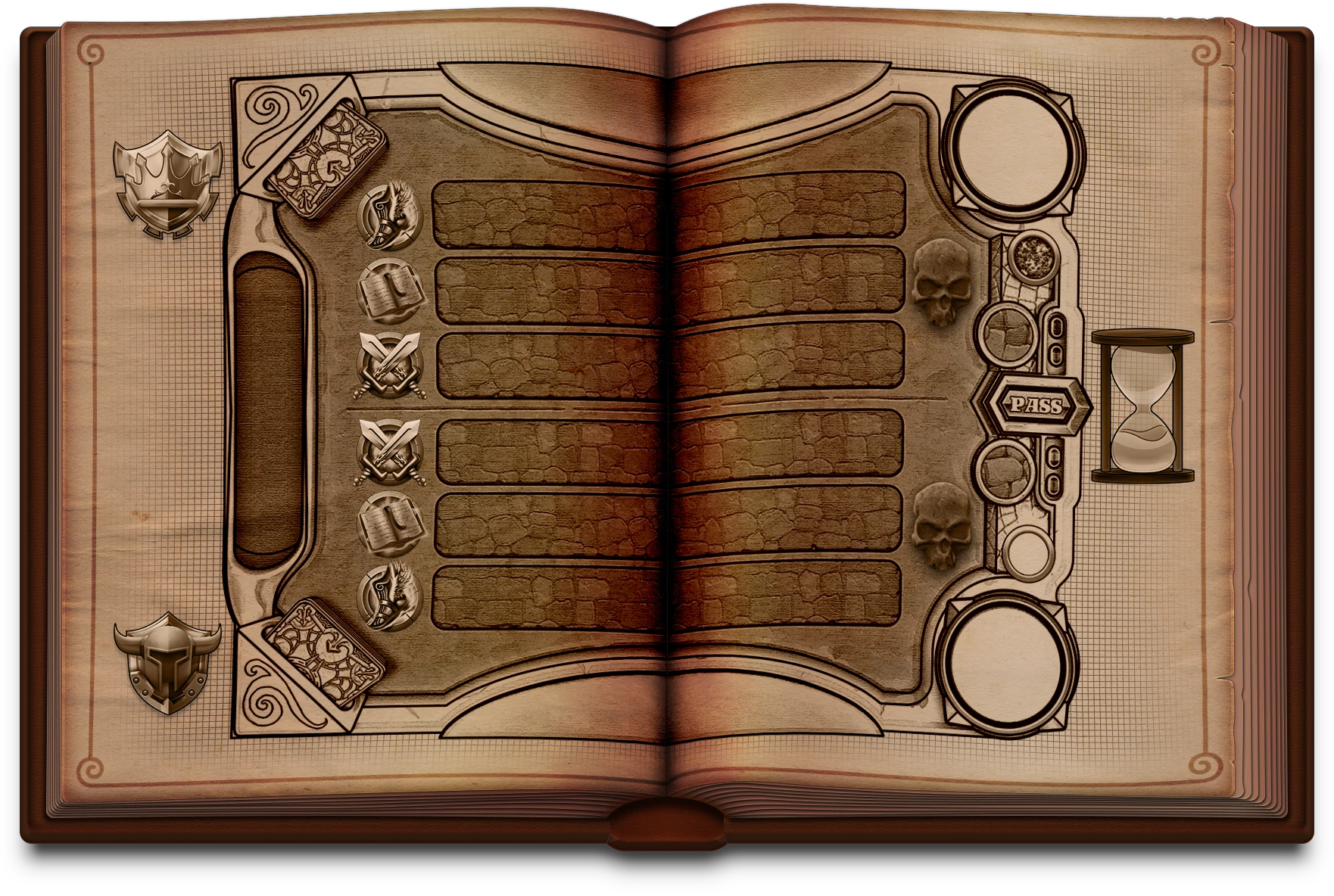
Each player has a mirrored half of the battlefield holding:
- Three territories — Strength, Agility and Intelligence. Six unit slots each.
- A hand of up to ten cards.
- A deck, shuffled once at the start of the match and never reshuffled.
- A graveyard, which holds units only, and which both players may open and read.
- A hero, face up from the first moment of the match, so your opponent can see what you might do with it.
- A Total Power figure, which is the sum of every unit you have on the board.
- Round-win orbs. One lights up for the player who won a round; on a drawn round, an orb lights on both sides.
- A pass control, and, online, a turn timer.
The game's own glossary describes the board this way:
"The Battlefield is divided to three Territories for each player, each representing an Affiliation: Strength, Agility or Intelligence. Units can only be placed in their appropriate Territory unless changed by Abilities or Spells."
How a match is decided
4.1Rounds
A match runs to a maximum of three rounds. The first player to win two rounds wins the match, and the match ends the moment that happens — a third round is played only when the first two rounds are split.
4.2Winning a round
When a round ends, each player's Total Power is measured and the higher figure wins the round. Total Power is one number: every unit you have on the board across all three territories, at its current power, plus any effect that adds directly to your Total Power rather than to a unit. It is not a count of territories won — holding two territories and losing the third by a wide margin loses the round.
"Every Unit has a Power Value. The player with the higher Total Power wins the round." — the game's tutorial
A card's power can be reduced to 0 but never below it, and an effect that drains your Total Power cannot take it below 0 either.
4.3A drawn round awards the round to both players
If both players end a round on exactly the same Total Power, both players are credited with a round win, and an orb lights on both sides of the board. This can end a match on the spot: a drawn round after each player has already won one leaves both on two round wins.
4.4Winning the match
- More round wins than your opponent wins the match.
- Equal round wins: the client awards the match to whoever has the higher Total Power at that moment.
- Equal round wins and equal Total Power: the match is a draw.
- A forfeit, a disconnect, or four missed turns in a row overrides all of the above and hands the match to the other player.
4.5Who goes first
- Every match opens with a coin toss.
- The coin-toss winner takes the first turn of round 1.
- Round 2 is opened by the player who lost the toss.
- Round 3 is opened by the player who won the toss.
The previous round's result never decides who starts the next round. Campaign stages are the one exception: some stages script which side opens the match and the later rounds.
Turns
5.1One action per turn
A turn is exactly one of these three things:
- Play a card — a unit into its territory, or a spell.
- Use your hero's ability — which costs the turn exactly as a card would, so you never do both in one turn.
- Pass — which ends your participation in the round.
Once you have acted, the rest of your hand and your hero stop responding until your next turn. There is no cap on how many cards you may play across a whole round; the round simply runs until both players have passed.
A card that is already on the battlefield cannot be picked up or moved again.
5.2If you have nothing to play
If you hold no playable card and your hero ability is spent, the game passes for you automatically. "Nothing playable" includes the case where every card in hand belongs to a territory that is already full.
5.3What abilities can do to a turn
Card abilities can bend the turn rules, and the card text always says so:
- grant a player one or more extra consecutive turns;
- forbid passing for a number of turns;
- force a player to play a spell as their next card, or forbid spells.
All four wear off at the end of the round.
5.4The hero ability is once per match
Your hero sits face up beside the board from the start of the match. Its ability can be used once per match, not once per round, and using it costs that turn.
"A Hero is a special card you choose when building a Deck. When the match begins, it is visible to your opponent and can be used once in a match." — the game's glossary
Passing, and how a round ends
- Pass is a press and hold control, so it cannot be hit by accident.
- Once you pass you are out for the rest of the round: no more units, spells or hero ability.
- Your opponent keeps taking turns, one after another, for as long as they like.
- The round ends when both players have passed. Nothing else ends a round on its own — an empty hand ends your round only because it makes the game pass for you.
"When you wish to end your plays for the rest of the round, press and hold the Pass button. You will not be able to play any Unit, Spell or Hero cards afterward until the round ends. A round ends when both players pressed Pass." — the game's glossary
There is no special rule for passing in the deciding round.
The turn timer, and what happens if you run out of time
The timer runs in online matches (including matches against a server bot).
Single-player has no timer at all.
| Missed turns so far | Time for the next turn |
|---|---|
| 0 | 60 seconds |
| 1 | 30 seconds |
| 2 | 15 seconds |
| 3 or more | 15 seconds |
The penalty escalates with each turn you let expire:
| Miss | What happens |
|---|---|
| 1st | The first card in your hand is played for you. |
| 2nd | A random card is destroyed out of your hand. If your hand is empty, you are passed instead. |
| 3rd | You are passed for the rest of the round. |
| 4th | You forfeit the match. |
Making a real play resets your missed-turn count to zero, and so does passing by hand. You are also warned before the clock runs out: the opponent's "hurry up" prompt can fire 25 seconds into your turn, and a sound plays with 10 seconds left.
If a client stops responding altogether, the opponent's client claims the win 60 seconds after that player's turn should have ended, and the server confirms it.
Your hand, your deck, and drawing
8.1The opening hand and the pre-match swap
Each player draws 10 cards. Before the match starts you are shown those ten and may swap up to 3 of them. You have 50 seconds to decide.
The card you get back is the next one down your deck. What happens to the card you threw away depends on what it was:
- a unit goes to your graveyard — it is out of the match;
- a spell goes back to the bottom of your deck.
8.2Later rounds
At the start of round 2 and again at the start of round 3, each player draws 2 cards, and then gets a swap screen showing their whole hand, on which they may swap 1 card, with 15 seconds to decide. The same unit-to-graveyard / spell-to-the-bottom rule applies.
Nothing else refills your hand. Winning or losing a round draws you no cards. Ten cards plus four is the whole match, unless a card ability draws more.
8.3The ten-card hand limit
You may hold at most 10 cards. A card drawn into a full hand is discarded unseen — a unit to the graveyard, a spell out of the match.
"Each player may have up to 10 cards in his hand. Every card that will be drawn after the hand is full will be discarded." — the game's glossary
8.4The deck
The deck is shuffled once, by the server, when the match is created, and both clients play from that same order. It is never reshuffled, the graveyard is never recycled into it, and if a draw is called for when the deck is empty, nothing is drawn. Running out of cards does not lose you the match.
Playing a card
9.1Units go where their affiliation says
A unit's affiliation — Strength, Agility or Intelligence — is the only territory it may enter. Dropping it anywhere on the battlefield puts it in that territory; there is no choice to make and no way to place it elsewhere.
Three cards in the whole game are exempt, and each says so on the card: Skin Changer, Werewolf and Lady Elana choose any of your three territories. A unit that ends up in a territory that is not its own takes on that territory's affiliation for as long as it is there.
9.2A full territory
Each territory holds 6 units per player. While a territory is full, every card belonging to it is simply unplayable — it stays in your hand rather than being discarded, and if that is all you hold, the game passes for you.
9.3Spells
A spell is played onto the battlefield but never occupies a unit slot and never adds power of its own. What happens to it next depends on its ability:
- an Active spell resolves and is destroyed immediately;
- a Passive spell is parked out of sight and keeps working until the round ends, at which point it is destroyed.
Spells never go to a graveyard, and nothing brings a spell back.
9.4Summoned units
A unit that reaches the battlefield without being played from a hand — out of a deck or back out of a graveyard — is marked Summoned, and the board shows that mark. Summoned units count toward Total Power exactly like played ones and go to the graveyard exactly like them. Some abilities that summon a unit deliberately strip its ability first, and the card text says so when they do. Several cards care whether their target is Summoned.
The graveyard
- Only units ever enter a graveyard. Spells and heroes never do.
- A unit goes there when it is destroyed, discarded, sacrificed, swapped away during a redraw, drawn into a full hand, or when the round ends.
- Both graveyards are open to both players. Press the skull to page through them, eight cards to a page.
- There is no size limit, and cards in a graveyard are never shuffled back into a deck. They come back only when a card ability reaches in and takes one, and a unit that returns that way is marked Summoned.
"A Unit goes to the Graveyard when being destroyed, discarded or when a round ends. Press the Skull in order to show all the Units in the Player's Graveyard." — the game's glossary
What happens between rounds
When a round ends:
- Every unit on both battlefields goes to its owner's graveyard. Nothing stays on the board, and no power carries over.
- Parked spells are destroyed and their effects end.
- Weather effects are cleared from every territory.
- Both Total Power figures reset to zero.
- Turn restrictions from abilities (extra turns, no-pass, spell-only) are cleared.
- Each player then draws 2 cards and gets their one swap.
What survives into the next round: the cards in your hand, your deck, your graveyard, your round wins, and whether your hero ability has already been used.
The one exception to "everything leaves the board" is a card whose own ability resurrects it at the start of the next round; those cards say so.
Forfeit, disconnect and reconnect
- The forfeit control ends the match immediately and hands the win to your opponent.
- Disconnecting loses you the match. The server marks the disconnecting player as the loser and closes the match normally, so the result counts exactly like any other loss. There is no extra penalty for the disconnect itself.
- Your opponent is told you disconnected and is credited with the win, but only if the match had actually begun. Failures before the first turn — a match that never starts, an opponent who never gets ready — send both players back to the menu without a result.
- There is no way to rejoin a match you have dropped out of. Board state is re-synchronised only inside a live session.
Abilities: the two things every ability line tells you
Almost every card does something beyond its power, and the first words of the ability line say when it happens.
Active — the effect happens on the turn the card is played, once.
"Active — Activates an Ability when card is played."
Passive — the effect keeps working for as long as the card is on the battlefield, and ends when the card leaves it.
"Passive — Works as long as the card is on the Battlefield."
A card can carry both. Some cards start Active and turn themselves Passive when a condition is met; the card text spells out both halves. Reading the line in order tells you the sequence: what happens now, and what keeps happening afterwards.
Separately, an ability either resolves automatically the moment the card is placed, or it asks you to choose a target — a card, or a whole territory — before it does anything. When a choice is needed the game shows you which cards and territories are legal targets (see Targeting).
Power is not accumulated from turn to turn. At the end of every turn the game rebuilds each unit's power from its printed value and re-applies every effect that is still in force, in a fixed order: ordinary abilities first, then weather, then the abilities that need to see the final numbers (for example a unit that counts how many other units are affected by a storm). Within each of those, active effects are applied before passive ones, and where two effects touch the same card, the most recent one wins. The practical consequence: when an effect stops applying, the power it was giving disappears on the next pass rather than sticking.
A unit's power can be reduced to 0 but never below it.
Keyword reference
These are the twelve keywords the game itself explains, on the enlarged card view. The wording is the game's own.
| Keyword | What the game says |
|---|---|
| Active | Activates an Ability when card is played. |
| Passive | Works as long as the card is on the Battlefield. |
| Immunity | Cannot be targeted by Spells and Abilities. |
| Battle Formation | Choose between several Abilities. |
| Summon | Units that are brought to the Battlefield by other cards. |
| Sacrifice | Destroys a Unit to activate an Ability. |
| Shield Wall | Cannot be targeted by Spells and Abilities. |
| Disable | Resets a Unit to its base Power and removes its Ability. |
| Dragon | A type of Unit that synergize with other Units of the same type. |
| Elemental | A type of Unit that synergize with other Units of the same type. |
| Weather | Firewall, Blizzard or Thunderstorm Spells. |
| Discard | A Unit that is sent to the Graveyard. |
Dragons are six cards: Benarath, Ganglionor, Blacktails, Prismatic Wyrm, Garuganoth and Kal'zaerim the Malignant. Elementals are four: Elemental Spirit, Fire Elemental, Water Elemental and Air Elemental. Cards that name either type care only about that type.
Battle Formation
A Battle Formation card asks you to pick one of two or three abilities the moment you play it. The options appear as cards in the middle of the board with their text on them, and you click the one you want.
- The choice is not optional and cannot be cancelled. Once the card is played the game waits for your click, and nothing else on the board responds until you make it.
- Choosing costs you nothing extra. The card is your one action for the turn, whichever option you take.
- Pick carefully: if the option you chose has no legal target, the card is spent for nothing and your turn ends. The game does not offer you the other option as a fallback, and does not give the card back.
Thirteen collectable cards use Battle Formation: Rogue, King Chopa, Dispel, Unhallowed Ground, Battlemarch, Lady Elana, Skin Changer, Werewolf, Air Elemental, Covering Fire, Lightning Bolt, Metamorphosis and Dream Catcher. The Elder Sisters uses the same mechanism to offer you a choice between three real cards to summon.
Immunity, and Shield Wall
Immunity means a unit cannot be picked as the target of a spell or an ability.
What it protects against:
- being targeted by any card that asks the player to choose a target;
- automatic effects that would otherwise reach it, including enemy area effects and weather.
What it does not do:
- it does not stop the unit counting toward Total Power, and it does not free up its slot in the territory;
- it does not save the unit at the end of a round — every unit goes to the graveyard then;
- and it cuts both ways: an immune unit also stops receiving your own allied buffs, because those reach it the same way an enemy effect would.
Two cards in the game can strip Immunity, and both say so on the card: Deadly Archer (which can take an allied unit's Immunity and reduce or steal it, or strip an enemy's Immunity and weaken it) and Lightning Bolt (which strips an enemy's Immunity and reduces it heavily). Disable also clears it, since it resets the unit completely.
Shield Wall carries the same on-screen description but is stronger: it can never be targeted by anything at all, with no exception card. It appears only on campaign cards, so you will not meet it in a normal collection or match. Three cards carry it, all of them Nature Mythicals you face in the campaign: Primordial Watcher, Heart of the Forest and The Lady of the Lake.
Disable
Disabling a unit resets it to its printed power and takes its ability away. That means:
- every bonus or penalty an ability had put on it disappears;
- the passive it was giving other units stops;
- anything it had registered to trigger later never fires.
It keeps its printed power, and any permanent power it had gained outside an ability.
Disable lasts for the rest of the round. Nothing in the game removes it — the unit stays an ability-less body until the round ends and it goes to the graveyard with everything else.
Cards that disable: Medusa, Dark Ranger, Paralysis, Sorceress, Negation Ritual (a whole territory, and it gives each disabled unit +2 Power) and Powerlust (which may only target a unit that has a Passive ability, and gives it +5 Power).
Heroes can never be disabled.
Weather: Firewall, Blizzard and Thunderstorm
Three spells put weather on a territory:
| Spell | Territory it hits | Effect |
|---|---|---|
| Firewall | Strength | −4 Power |
| Blizzard | Agility | −4 Power |
| Thunderstorm | Intelligence | −4 Power |
The rules that matter:
- Weather hits that territory on both sides of the board, yours included. It is not aimed at an opponent.
- It hits every unit in the affected territory, and any unit played into it afterwards is hit as well.
- It lasts for the rest of the round. There is no per-turn countdown. At the end of the round it clears with everything else.
- The spell card itself stays on the board, out of sight, for as long as the weather lasts.
- Dispel removes weather: one of its Battle Formation options clears it from the whole battlefield, the other clears it only from your own three territories.
- The reduction stacks with everything else and is applied after ordinary abilities, so a unit's final number already includes it.
- Immune units are not affected, for the same reason they are not affected by anything else.
A handful of cards change what weather does where they stand, and each says so on the card. Thunder Lord, Stormcaller and Water Elemental are not reduced by Thunderstorm at all — they are built to profit from it. Timberlord cancels Firewall in its own territory, Benarath turns Blizzard into +4 in its own territory, Fire Elemental grows under Firewall, and Stone Slinger doubles its power under Blizzard. Other cards get stronger while any weather is on the board, and Unhallowed Ground may only be cast on a territory that is already under weather.
Sacrifice
A Sacrifice card destroys one of your own units to pay for its ability. You choose which one, by clicking it; the sacrificed unit goes to your graveyard and counts as having died in battle, so anything that reacts to a death reacts to this.
You cannot sacrifice an opponent's unit.
The cards, and what they buy: Golem Zaya gains +13 Power. Water Naga gains Immunity and the sacrificed unit's power. Barghest gains a passive giving every other allied unit in its territory +2 Power.
Targeting, and what happens when there is no legal target
When a card asks you to choose, the legal targets glow blue.
"Some cards can target other cards with their effects. If a card can be targeted it will have a blue glow." — the game's tutorial
Territories glow the same way when a card targets a whole territory, and a line is drawn from the card that is asking to the target you hover.
Each card carries its own targeting rules: your side or your opponent's, on the battlefield or in a hand, a deck or a graveyard, one affiliation or any, and sometimes an extra condition — The Haunting Lady may only take an enemy unit of 3 power or less and only if there is room for it on your side, Powerlust may only target a unit that has a passive ability, Deadly Archer may only target an immune unit, and so on. A card can never target itself.
If nothing legal is on the board when the ability looks, the ability does nothing, the card is still spent, and your turn ends. This is the single most expensive mistake available in Runewards, and it is why reading a card before playing it matters: Sacrifice with no other allied unit out, a graveyard effect with an empty graveyard, or a Battle Formation option whose targets are not there.
Heroes
- Every deck has exactly one hero, and you choose it first. The hero must belong to the deck's faction, and it is not part of the deck's card count.
- The hero is not on the battlefield. It sits in its own place at the side of the board, and it never occupies a unit slot.
- Your hero is face up from the first second of the match, and so is your opponent's. You are meant to read it and plan around it.
- A hero has no power and adds nothing to Total Power by simply being there.
- Its ability may be used once per match, not once per round, and using it costs that turn exactly as playing a card would.
- A hero can never be targeted, destroyed, disabled or sent to a graveyard. Nothing in the game reaches it.
- Two heroes work differently by design: Hyperion and Lord Hyperion are permanent passives that add Total Power at the start of every round rather than being activated, and The Elder Sisters recharges every round.
Twelve heroes can be built with, four for each faction:
| Faction | Heroes |
|---|---|
| Humans | Archmage Leshar, General Jandor, The Prophetess, Hyperion |
| Nature | Primordial Watcher, Spirit of the Forest, The Haunting Lady, The Elder Sisters |
| Monsters | Lazarus the Archlich, Necromancer, Terror Knight, Nephilim |
New players start with three of them: Hyperion (Humans), Spirit of the Forest (Nature) and Nephilim (Monsters).
Three of the twelve are upgraded permanently by the campaign, and after that you build with the upgraded version instead: Hyperion becomes Lord Hyperion at stage 5, Nephilim becomes Balor at stage 10, and Spirit of the Forest becomes Heart of the Forest at stage 15 (see the campaign). Neither the upgrades nor any other hero can be crafted.
Fifteen further heroes lead the campaign's own opponents. You never own those.
Building a deck
22.1What makes a deck legal
| Rule | Value |
|---|---|
| Units | at least 20, at most 28 |
| Spells | at least 6, at most 14 |
| Hero | exactly 1, and it does not count toward the numbers above |
| Mythical cards | at most 4 |
| Unique cards | at most 10 |
| Rare and Basic cards | no limit beyond the unit and spell counts |
So a deck holds between 26 and 42 cards, plus its hero.
The deck builder will not let you go over a maximum: it stops the card and says so. Falling short of a minimum is a warning rather than a wall — press Done with too few cards and the innkeeper tells you what is missing and turns to the right page; press Done a second time and the deck is saved anyway. A deck that is short of the minimums simply cannot be taken into a match.
Fill Deck completes a half-built deck to the legal minimum for you, respecting every limit, and switches itself off once the deck is legal.
22.2One faction per deck
You choose the faction first — Humans, Nature or Monsters — and the deck can hold cards of that faction only, plus Mercenaries, which any deck may hire. Mercenaries is not a faction you can build around: it has no heroes and no deck of its own.
New players start with Humans. Monsters unlocks when your Humans reach level 2, and Nature unlocks when your Monsters reach level 2.
22.3The hero
After the faction, you pick the hero, from the heroes of that faction that you own. You can change a deck's hero later, within the same faction. The hero is not part of the deck's card count.
22.4Copies of a card
How many copies of one card a deck may hold is a property of the card, shown on the card itself, and it follows rarity:
| Rarity | Copies |
|---|---|
| Hero | 1 |
| Mythical | 1 |
| Unique | 2 |
| Rare | 2 |
| Basic | 3 |
Eight cards break the pattern deliberately and say so on the card: Rhanger the Archon, Assassin and Mana Leech are Mythicals that allow 2; Gyroplane, Elder Bear, Blood Shaman and Ashenwalker are Rares that allow 3; and Crusader is a Basic that allows 2.
You are also limited by what you own: you can put in as many copies as the card allows or as many as you have, whichever is fewer. When a card is maxed out in the deck it shows a lock and its counter reads Deck Limit.
22.5Decks you keep
You may keep 9 decks. A deck name is up to 20 characters; if you reuse a name the game adds a number to keep them distinct. Long-press a deck to delete it, and emptying a deck of all its cards deletes it too.
New accounts get no deck: you are given cards and three heroes and you build your first deck yourself, which the tutorial walks you through.
Your collection
The game holds 258 cards. Of those:
- 207 can end up in your collection. 192 of them can be crafted; the other 15 are campaign rewards only (see below).
- 51 can never be yours. These are the campaign's own 15 boss heroes, 30 campaign units and spells, and 6 cards that exist only to be summoned by other cards or used in the tutorial.
The breakdown of what you can collect:
| Faction | Hero | Mythical | Unique | Rare | Basic | Total |
|---|---|---|---|---|---|---|
| Humans | 5 | 4 | 5 | 18 | 20 | 52 |
| Nature | 5 | 4 | 7 | 16 | 17 | 49 |
| Monsters | 5 | 4 | 5 | 14 | 22 | 50 |
| Mercenaries | 0 | 7 | 12 | 19 | 18 | 56 |
| Total | 15 | 19 | 29 | 67 | 77 | 207 |
By affiliation: 49 Intelligence, 53 Agility, 53 Strength, 37 Spells, 15 heroes.
New accounts are granted 64 card copies and three heroes — Hyperion (Humans), Spirit of the Forest (Nature) and Nephilim (Monsters) — plus the Default card back.
Cards reach you from: the opening grant, chests, crafting, fusion, campaign stage rewards, quest and Journey and daily rewards, and adventure rewards.
In the deck builder you see only the cards you own. Switch to crafting mode and the whole collectable set appears, with the cards you do not own greyed out and the ones you can craft picked out in green.
Crafting and salvaging
Crafting is paid for in Runes. Salvaging a spare copy pays Runes back.
| Rarity | Craft | Salvage |
|---|---|---|
| Basic | 20 | 5 |
| Rare | 100 | 20 |
| Unique | 400 | 100 |
| Mythical | 1600 | 400 |
- Heroes cannot be crafted or salvaged. Neither can the 15 campaign-upgrade cards, nor any campaign or event card.
- You can craft a card only up to the number of copies it allows.
- Salvage All sells only the copies you hold above a card's limit, so it can never break a deck.
- When a reward would give you more copies of a card than it allows, the extra is turned into Runes on the spot.
- The tutorial hands you the Runes for your first Rare craft, and crafting stays closed to a brand-new player holding fewer than 40 Runes.
Fusion
Fusion turns spare cards into a different one, for free. You put cards in, and you get back one random card of the rarity the recipe produces. The cards you put in are gone.
Four of the same rarity is a re-roll — you get another card of that same rarity. Mixing in lower-rarity filler is how you climb a tier, and it costs more cards:
| You put in | You get |
|---|---|
| 4 Basic | 1 Basic |
| 4 Rare · or 3 Rare + 4 Basic · or 2 Rare + 8 Basic · or 1 Rare + 12 Basic · or 16 Basic | 1 Rare |
| 4 Unique · or 1 Rare + 3 Unique · or 3 Unique + 6 Rare · or 1 Unique + 11 Rare · or 16 Rare | 1 Unique |
| 4 Mythical · or 2 Rare + 5 Unique · or 1 Rare + 9 Unique · or 13 Unique | 1 Mythical |
Fifteen recipes in total, and only an exact match works — the game tells you when a combination is not one of them. Heroes are never produced by fusion.
Card backs
Card backs are cosmetic: they change the back of your cards during a match. There are ten, and one is always yours.
| Card back | How you get it |
|---|---|
| Default | Yours from the start |
| Simple | Craft for 400 Runes (salvages for 100) |
| Winter | Craft for 400 Runes (salvages for 100) |
| Humans | Reach level 31 with the Humans race |
| Monsters | Reach level 31 with the Monsters race |
| Nature | Reach level 31 with the Nature race |
| Runemaster | Win 500 matches with any race |
| Archon | Reach the Archon league in ranked multiplayer |
| Halloween | The Halloween pack |
| Valentine | The Valentine pack |
The last three are not obtainable in this build: ranked play is switched off, and the two event packs are not in the shop. They stay in the game for when the events return.
Gold and Runes
Two currencies, and they do different jobs.
Gold buys things in the shop:
| Item | Gold |
|---|---|
| Golden Chest | 100 |
| Chained Chest | 140 |
| Thorn Chest | 200 |
| Spider Chest | 300 |
| Storm Chest | 500 |
| Ancient Chest | 850 |
| Campaign Act II | 300 |
| Campaign Act III | 500 |
| Adventure level 2 / 3 / 4 / 5 | 50 / 75 / 100 / 125 |
| Rune packs | 100 → 55 · 200 → 120 · 350 → 230 · 500 → 350 · 750 → 600 · 1000 → 900 |
Gold comes from quests, the Journey, adventure rewards and the daily reward.
Runes are for crafting: cards, and the two craftable card backs. Nothing else costs Runes. They come from salvaging spare cards, from the Journey, from campaign chapters, from adventure rewards, from the daily reward, and from rune packs.
Gold packs can be bought with real money, through the store the game was installed from. Everything else in this section is earned by playing: Gold from quests, the Journey, adventure rewards and the daily reward, Runes from those and from salvaging. Nothing in the game is reachable only by paying.
Chests
A chest holds five cards and nothing else.
| Chest | Gold | What is inside |
|---|---|---|
| Golden Chest | 100 | 5 Basic slots |
| Chained Chest | 140 | 4 Basic + 1 Rare |
| Thorn Chest | 200 | 3 Basic + 2 Rare |
| Spider Chest | 300 | 4 Basic + 1 Unique |
| Storm Chest | 500 | 3 Basic + 2 Unique |
| Ancient Chest | 850 | 4 Basic + 1 Mythical |
A Basic slot is a lottery, and this is where the good cards come from:
| Result | Chance |
|---|---|
| Basic | 88% |
| Rare | 11% |
| Unique | 0.5% |
| Mythical | 0.25% |
A Rare, Unique or Mythical slot always pays a card of exactly that rarity. Cards you already hold to the limit are turned into Runes as they drop.
Your first chest is better than the one you buy later. During the tutorial the Golden Chest pays 3 Basic and 2 Rare, drawn only from Humans and Mercenaries, so that the cards are usable in the first deck you build.
Chests come from the shop, from quests, from the Journey (at race levels 5, 20, 25, 35 and 45), and from the daily reward (days 3, 9, 19, 24 and 30). The Ancient Chest is shop-only.
Levels: one ladder per faction
Experience is earned per faction, not per account. Your Humans, Nature and Monsters each have their own level, from 1 to 50.
What a match pays:
| Term | XP |
|---|---|
| Winning | 20, multiplied by the difficulty you beat (0.85 on Easy up to 1.0 on Insane) |
| Cards you played | 3 XP for every 5 cards, counting up to 40 cards |
| Rounds played | +2 for a match that reached round 2, +1 otherwise |
A loss still pays for the cards and rounds you played. The most a single match can pay is 46. Early campaign stages pay a bonus on top: stage 1 multiplies the win by 1.5, falling to 1.1 by stage 5.
The ladder gets steadily longer, from 25 XP for level 2 to about 1,200 for level 50, which is 24,565 XP in total:
| Level | Total XP | Level | Total XP |
|---|---|---|---|
| 2 | 25 | 30 | 7,153 |
| 5 | 163 | 31 | 7,725 |
| 10 | 648 | 35 | 10,296 |
| 15 | 1,514 | 40 | 14,196 |
| 20 | 2,837 | 45 | 18,927 |
| 25 | 4,692 | 50 | 24,565 |
Levelling up pays a Journey reward for that level (see below), and every second level of a faction pays a Golden Chest. Levels also open things up: Monsters at Humans level 2, Nature at Monsters level 2, and the Adventure once all three factions are at level 2.
The Journey
The Journey is a permanent list of one-off rewards, in seven tracks. A step pays once, ever, and waits in your Journey screen until you collect it.
Three level tracks, one per faction, 49 steps each. Every level from 2 to 50 pays something: gold and runes alternating, growing from 5 to 60, with a card or a chest at the milestones.
| Level | Reward |
|---|---|
| 5 | Golden Chest |
| 10 | A Hero card |
| 15 | A Rare card |
| 20 | Chained Chest |
| 25 | Golden Chest |
| 31 | Your faction's card back |
| 35 | Thorn Chest |
| 40 | A Unique card |
| 45 | Spider Chest |
| 50 | A Unique card |
The campaign track, 15 chapters. Each chapter pays runes and XP once, from 10 runes and 10 XP for chapter 1 up to 50 and 50 for chapter 15, for 400 runes and 400 XP across the whole campaign.
The single-player track, 5 steps — the first win on each difficulty: Easy 20 runes, Normal 50, Hard 100, Expert 150, Insane 250.
The adventure track, 5 steps — finishing the fifth stage of each level: 25, 50, 75, 100 and 150 runes, each with the same amount of XP.
The multiplayer track, 6 steps — your first online win pays 10 gold, 10 runes and 10 XP, and then each league you reach pays more, up to 500 of each for Archon. Those league steps are unreachable while ranked play is off.
Card rewards are by rarity, not by name: the game gives you a random card of that rarity.
Quests
Quests are the day-to-day source of gold.
Your first seven quests come in a fixed order, one at a time. Finish one and the next appears. They are one-off and never come back:
| Order | Quest | Goal | Pays |
|---|---|---|---|
| 1 | Warrior | Play 5 units | 100 gold |
| 2 | Magi apprentice | Play 3 spells | 50 gold |
| 3 | Black Knight | Play 12 units | 50 gold |
| 4 | Tactician | Win a single-player match with Humans | 50 gold |
| 5 | Lord of the cards | Play 20 cards | 50 gold |
| 6 | Monster | Win a single-player match with Monsters | 50 gold |
| 7 | Nature | Win a single-player match with Nature | 50 gold |
The first one pays exactly the price of a Golden Chest.
After that, quests are dealt from a pool:
- You hold up to 9 quests at a time.
- Up to 3 new quests arrive per day, the first time you sign in that day (server midnight starts a new day). A day you do not sign in brings none, and staying signed in past midnight does not bring the next day's quests until you sign in again.
- A quest you have just finished is unlikely to be dealt again for 3 days.
- Most quests recycle. Fourteen are one-off milestones, such as winning 25 single-player matches or disabling 100 units, and each of those pays 150 gold.
- As you progress you are moved up through three quest pools, so the quests get bigger.
What quests pay: gold, from 10 to 150, and nothing else — except five quests that pay a Golden Chest. Two of those are the tutorial's own, and three are the "every second level" rewards for your three factions. The icon on a quest tells you roughly how much gold it pays: a small pile up to 20, a big pile up to 49, a bag up to 99, a sack for 100 or more.
There are also three separate achievements, one for each act of the campaign. These are not dealt to you; every player has all three from the start.
The daily reward
One reward per day, on a 30-day ladder. Claim it and you move one step along; after day 30 it starts again.
Missing a day costs nothing. There is no streak to keep and no penalty for being away: the ladder simply waits where you left it.
The ladder, day by day:
| Day | Reward | Day | Reward | Day | Reward |
|---|---|---|---|---|---|
| 1 | 10 gold, 10 runes | 11 | 10 runes | 21 | 10 gold, 10 XP |
| 2 | 10 runes, 10 XP | 12 | 20 gold | 22 | 10 runes |
| 3 | Golden Chest | 13 | 10 gold, 10 runes | 23 | 10 gold, 15 runes, 10 XP |
| 4 | 10 gold, 10 runes | 14 | 10 gold, 10 XP | 24 | Spider Chest |
| 5 | 5 gold, 5 runes, 10 XP | 15 | A Rare card | 25 | 10 gold |
| 6 | 10 runes, 10 XP | 16 | 5 gold, 10 runes, 5 XP | 26 | 10 runes, 10 XP |
| 7 | A Hero card | 17 | 10 runes | 27 | 10 gold |
| 8 | 10 gold, 10 runes, 10 XP | 18 | 10 gold, 10 runes, 10 XP | 28 | 10 runes |
| 9 | Chained Chest | 19 | Thorn Chest | 29 | 15 gold, 10 runes, 15 XP |
| 10 | A Rare card | 20 | A Basic card | 30 | Storm Chest |
Where you can play
| Mode | What it is | State |
|---|---|---|
| Tutorial | A scripted two-round duel that teaches the board | Everyone plays it once |
| Single-player against the AI | Pick a faction and a difficulty, bring your own deck | Open |
| Campaign | 15 story stages, each of which permanently upgrades one of your cards | Acts I to III playable |
| Adventure | 5 levels of 5 stages, escalating difficulty, gold and runes for every stage | Open once all three factions reach level 2 |
| Online, unranked | 1v1 against another player | Open |
| Friendly challenge | Invite a friend from your friend list | Works, needs a friend online |
| Ranked ladder | Rating, leagues, seasons | Switched off deliberately |
| Event campaign | Valentine content | Not active, no rewards configured |
33.1The tutorial
The first time you log in you play a scripted two-round match, on a fixed board, with a hero nobody else has. It teaches, in order: play a unit, power and Total Power, abilities and targeting, one card per turn, spells, passing, the two cards drawn each round, the three territories and affiliation, and the hero. It can be skipped.
After that the menu opens one door at a time: your first real single-player match against Monsters on Easy, then your first chest, then the deck builder, and then the whole game.
33.2Single-player against the AI
Five difficulties: Easy, Normal, Hard, Expert, Insane. Easy is open from the start, and beating the hardest difficulty you have unlocked opens the next one.
Difficulty changes the AI's deck, not how well it plays. The opponent's thinking is the same at every level; what grows is the deck it brings, from 18 cards at Easy to 34 at Insane, and those decks are the campaign's own stage decks regrouped by strength. The AI plays one card per turn like you, looks one move ahead by trying every card it holds on a copy of the board, and knows when to pass.
Winning on a higher difficulty pays more XP: from 0.85 of the win bonus on Easy up to the full amount on Insane.
33.3The campaign
Fifteen stages in three acts. Act I is free, Act II costs 300 gold and Act III costs 500 gold. Act IV is announced in the game as coming soon and cannot be bought.
You bring your own deck; the opponent's deck is fixed for the stage, and every stage has its own boss hero. The AI is given the first turn on stages 8, 10, 11, 13 and 15, and it plays its hero to a script on several stages.
Every stage permanently upgrades one card in your collection into a stronger version, and that is the only way to get those fifteen cards:
| Stage | Upgrade | Stage | Upgrade |
|---|---|---|---|
| 1 | Monk → Wise Monk | 9 | Reaper → Shadow Reaper |
| 2 | Lumberjack → Timberlord | 10 | Nephilim → Balor |
| 3 | Watchman → Guardian | 11 | Skin Changer → Werewolf |
| 4 | Magi Apprentice → Spellslinger | 12 | Boar → Dire Boar |
| 5 | Hyperion → Lord Hyperion | 13 | War Horse → Pegasus |
| 6 | Salamander → Water Naga | 14 | Jungle Hunter → Amazon Warrior |
| 7 | Manticore → Ancient Manticore | 15 | Spirit of the Forest → Heart of the Forest |
Three of those upgrades are heroes: Hyperion, Nephilim and Spirit of the Forest become Lord Hyperion, Balor and Heart of the Forest.
A stage also pays a Journey chapter reward (runes and XP) the first time you win it, and bonus XP that is largest in the early stages. Stages can be replayed: the XP comes again, the Journey reward does not, and your progress can never go backwards.
33.4The Adventure
Five levels of five stages each. It opens when all three of your factions have reached level 2. Level 1 is free; levels 2 to 5 are permanent unlocks costing 50, 75, 100 and 125 gold, and one full run of a level pays back more than the level cost.
Difficulty climbs inside each level and across them: level 1 runs Easy to Normal, level 5 is Insane throughout. Your opponent is drawn at random each stage.
Every stage you win pays a reward you collect from the Adventure screen. Each stage has a guaranteed floor, with better outcomes rolled on top: half the time the floor, 30% half again as much, 15% a card, and 5% a better card. A full run of a level guarantees, before any bonus:
| Level | Gold | Runes | XP | Card at the boss |
|---|---|---|---|---|
| 1 | 41 | 41 | 75 | Basic |
| 2 | 69 | 69 | 105 | Basic |
| 3 | 101 | 101 | 135 | Rare |
| 4 | 129 | 129 | 165 | Rare, sometimes Unique |
| 5 | 166 | 166 | 200 | Rare, often Unique |
Losing a stage costs you nothing — you play it again. To start a level over you need a reset, and you get one every 20 hours with never more than one saved up. A reset clears any reward you have not collected, so collect first.
33.5Online play
Unranked matches are open from the start, with no level requirement. The game looks for an opponent of similar rating and widens its search as it waits, taking anyone after about 45 seconds.
Friendly challenges are invited from your friend list, and you can watch a friend's match as a spectator.
The ranked ladder is switched off on purpose. It needs a population of players that does not exist yet, so the Ranked button is disabled and says so. Everything behind it is built and waiting: a rating that starts at 1000, ten placement matches, and six leagues — Bronze, Silver at 1100, Gold at 1250, Diamond at 1450, Master at 1700 and Archon at 2000 — with about 32 points changing hands on an even match. While ranked is off, the league rewards, the Archon card back and thirteen multiplayer quests are out of reach.
Your account, the client, and other players
Account rules. A username is 3 to 20 characters, lowercase letters and digits with dots, dashes and underscores allowed, and it must start with a letter or a digit. A password is 8 to 16 characters and must contain at least one lowercase letter and one digit. An email address is required and is verified by a link. A username can be changed once every 30 days. An account can be made in the game or on the website, and it is the same account either way.
Languages. The game ships in eight: English, Russian, Hebrew, Portuguese, German, French, Korean and Persian. Card text is fully translated into English, Hebrew, Russian and Portuguese; where a translation is missing you see the English line rather than a blank card.
Settings. Resolution, graphics quality, volume, a frame-rate cap for play and a separate one for when the window is in the background, and whether the game keeps running when it loses focus.
Other players. You can add friends, chat with them, invite them to a friendly match and watch their matches. During a match you can send your opponent one of your hero's emotes, and the game will nudge a slow opponent for you after 25 seconds.
Questions players actually ask
Do spells add power?
No. A spell has no power of its own. Its value is what it does.
Do I get a new hand every round?
No. You draw ten at the start of the match and two at the start of each later round. That is the whole match unless a card draws you more.
Can I play again after passing?
No. Passing ends your round. Your opponent can keep playing for as long as they like.
Can I put any unit in any territory?
No. A unit goes into the territory of its affiliation and nowhere else. Three cards in the game are exceptions and they say so.
What if my territory is full?
Six units per territory is the limit. While it is full you cannot play a card that belongs to it; the card stays in your hand.
Is the winner the player with the most power across the whole match?
No. Each round is scored on its own, and the match goes to the player who wins two rounds. A big win in one round is worth exactly as much as a narrow one.
What happens if we tie a round?
Both players are credited with winning it. If that puts you both on two, the match goes to whoever has more power at that moment, and is a draw if that is level too.
Do my units come back next round?
No. Every unit on the board goes to the graveyard when the round ends. Cards still in your hand stay.
Are cards in the graveyard gone for good?
Not necessarily. Several cards can bring a unit back, from your graveyard or your opponent's. Spells, though, never enter a graveyard and never come back.
Why did my card do nothing?
Almost always because it needed a target and there was none: no allied unit to sacrifice, an empty graveyard, no enemy unit with Immunity. The ability is skipped, the card is spent, and the turn ends. Read the card first.
Can I lose by running out of cards?
No. If your deck is empty, you simply draw nothing.
What happens if I disconnect?
You lose the match, and your opponent is credited with the win. There is no way to rejoin.
Is there a timer in single-player?
No. The 60-second turn clock runs in online matches only.
Why is my Total Power not what I expect?
It is recalculated from scratch every turn: every unit goes back to its printed power and every effect still in force is re-applied. If an effect has stopped applying, the power it was giving is gone. Weather is applied after ordinary abilities, and a unit's power can never go below 0.
How do I unlock Monsters and Nature?
Reach level 2 with Humans for Monsters, and level 2 with Monsters for Nature. Levels are per faction.
Why can I not play ranked?
It is switched off on purpose until there are enough players for a ladder to mean anything. Unranked online matches are open to everyone.
What is the fastest way to a specific card?
Craft it, if it is craftable: 20 Runes for a Basic, 100 for a Rare, 400 for a Unique, 1600 for a Mythical. Salvage the spares you will never play to pay for it.
Can I get a hero from a chest or by crafting?
Not by crafting. Chests and rewards can pay a hero card, and the Journey pays one at level 10 of a faction. Three more heroes come from campaign stages 5, 10 and 15.
Where the wording and the behaviour disagree
These are real, and a player may well notice them at the table. In each case the game does what the third column says.
| Where | What it says | What the game does |
|---|---|---|
| The in-game glossary, on the timer | "The third time — the match ends in a forfeit" | The third missed turn passes you for the round; the fourth forfeits the match |
| The in-game glossary, on territories | "Additional Units will be discarded and sent to the Graveyard" | A card belonging to a full territory is simply unplayable and stays in your hand. Discarding on overflow is what happens to a full hand |
| Sand Raider | "+4 Power instead of -4" under weather | Its power under weather becomes +5 |
| Werewolf | says nothing about weather | Its power under weather becomes +3 |
| Water Elemental | says nothing about Thunderstorm | Is not reduced by Thunderstorm |
| A match that ends level on round wins | the client names the player with more Total Power as the winner | the server records the match as a draw, so the result you see and the result that is stored can differ |
| Immunity and Shield Wall | both read "Cannot be targeted by Spells and Abilities" | Shield Wall is absolute; Immunity can be stripped by Deadly Archer and Lightning Bolt. Shield Wall appears only on campaign cards |